Monday, June 10, 2013

The Panama Hat Story

Why is a hat from Ecuador called a "Panama" Hat????


Beginning in the early to mid-1600's hat weaving evolved as a cottage industry all along the Ecuadorian coast.  Hat weaving and wearing grew steadily in Ecuador through the 17th and 18th centuries.  Even then, the best quality hats were being made in what is now the province of ManabĂ­.  Hats woven there gained a reputation for being better quality, finer, than woven elsewhere.

Ecuador had those beautiful straw hats it wanted to sell and did not have the tourists or people passing through to somewhere else to buy them.  Just a few hundred miles to the north, a relatively short boat trip away is Panama.  In the 1800's Panama was part of what now is Colombia.  Then, Colombia was called New Granada.  Unlike Ecuador, Panama was a very busy corner, with lots of people passing through and working there.

Before air travel, anyone on the East Coast of Canada or the United States who wanted to go to the West Coast (or vice versa) had three choices: (1) travel overland, (2) take a ship around the tip of South America, (3) take a ship to Panama, cut across the isthmus, and get another ship on the other coast.  Option number three was the fastest, and probably the least hazardous, of the choices.

Then gold was discovered in California, and the number of people passing through Panama exploded exponentially.  Since the straw hats are strong, lightweight, attractive, they were much in demand.  They are perfect for deflecting the tropical sun of Panama, just the thing for those long days in sunny California while getting rich panning for gold, and they're even nice to have on a summer day in Philadelphia or Boston.

The Panama Canal workers often wore the hats, which showed up pretty well in the black-and-white news photos of the day.  One photo, made in November 16, 1904, is often credited as the original as the origin of both the name and fashion.

The photograph showed President Theodore Roosevelt wearing a black-banded straw hat as he sat at the controls of a ninety-five-ton Bucyrus steam shovel during a three day inspection tour of the Panama Canal excavation.  The picture was widely published in the U.S., and around the world, prompting much comment of the President's "Panama" hat.

People on the way to the gold fields bought the "Panama" hats.  People returning from the gold fields also bought the straw "Panama" hats.  When, people got home and someone comments "Nice hat.  Where'd you get it?"  The response was, of course, "Panama".  Those hats were made in Ecuador and didn't have the stickers inside stating "Made in Ecuador".  Ecuadorians themselves do not call their hats Panama hats.  In Ecuador, the hats are called sombreros de paja toquilla, or "hat of toquilla straw".

Did you also know that the art of weaving was added to the UNESCO Intangible Culture Heritage Lists on December 6, 2012?

The traditional brimmed straw hat  There are two main processes in the creation of a "Panama" hat, weaving and blocking.  The hats are commercially graded with numeric degrees to indicate quality, but these vary by seller.  The rarest and most expensive hats can have as many as 1600 to 2500 weaves per square inch.

Although the "Panama" hat continues to provide a livelihood for thousands of Ecuadorians, fewer than a dozen weavers who are capable of making the finest "Montecristi superfinos" remain.

The ladies hats are in one section of the shop............there are so many different styles it would be hard to choose one.
The men's section of ready made hats...a great place to try on different styles and see what you like and then have them custom make yours....

It was time for Ed to buy the tradition straw hat now made in Cuenca.  There is a place here that will custom make your hat.  First you have to understand about the different qualities of weave available.  They can be priced from $35 up to a couple of thousand  dollars.  Ed could tell the difference from the cheaper quality weave to the mid-range.  OK, he selected the quality of weave he wanted and now it was time to design the height of the top and width of the brim.  Our seller said he would make two hats and return in 3 hours.


When we returned, there were two very different hats for Ed to try and see if he liked either one.  The top picture has a more open weave top and we liked that but the brim was too narrow for Ed.  The bottom picture was a little finer weave and had a solid woven top but a wider brim & that was the hat Ed selected.  Now, Ed needed to select the type band for that hat.  He didn't want the traditional black cloth band so he went with black leather.
Putting the new leather band on Ed's hat....
Ed wearing his new custom hat...looks pretty snappy to me!

The problem is now that Ed has his new hat, it sits in the closet because he doesn't want to get it wet or dirty....

You see the hats being worn all over Ecuador - each with a personal touch - with a pretty blue band for this lady.

Towns around Cuence - Day Trip

On April 19, 2013 Ed and I took a day trip with Juan, a local guide, to see a couple of the towns east of Cuenca, known as craft villages.  We were eager to do more exploring.  The drive was as enjoyable as seeing the villages, just beautiful scenery around every turn of the road.  Juan even stopped the car for my photo opportunities.
 
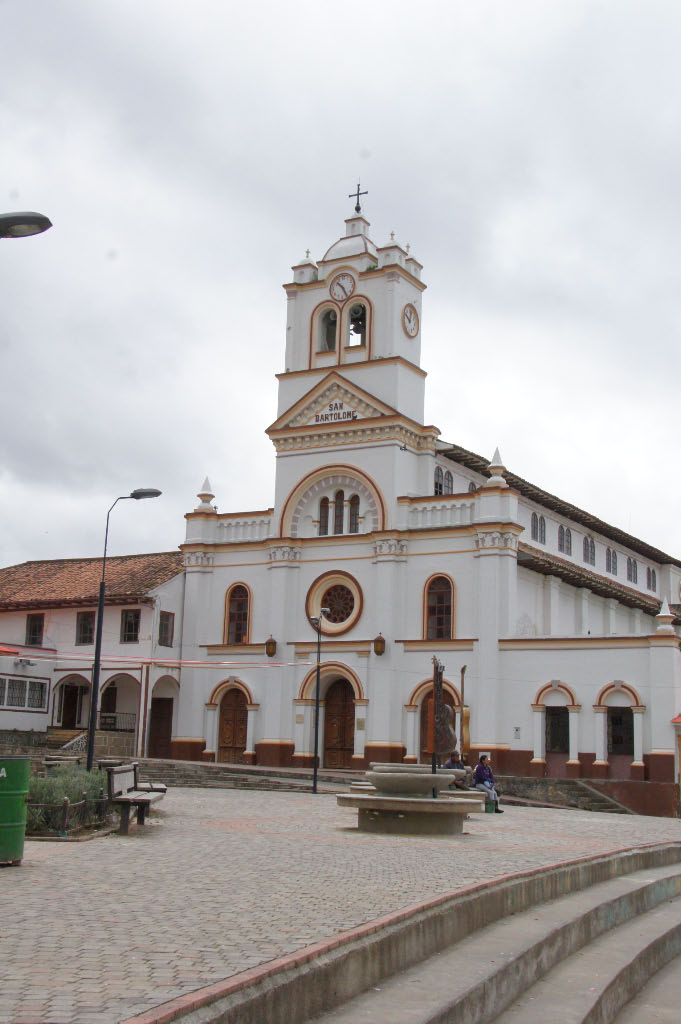
 Our first stop was in the hillside village of San Bartolome.  It is in this village were generations of craftsmen have been making beautiful hand-made guitars.  We stopped at one place to see the quality of their work and Ed just had to try a couple out.  The son of the maker explained the woods used, how they did the inlaid part and how long it took to make one guitar.  I could not believe how much work went into making just one guitar.
The church on the main square of the village and this guitar in front of the church....really tells you about the village & how proud of their guitars


Ed found the guitar that had an easy action and a lovely bass sound and bought it (happy 45th anniversary).  He has now gotten back to his music that he had missed.

We stopped in one home/cafĂ© for the guys to have a morning cup of coffee.  While we were waiting for the coffee, Juan showed us that lady also raised guinea pigs.  Roasted guinea pig (Cuy) is a treat in Ecuador and Peru.  They're just too darn cute to eat....sorry!

Our next village was more to my liking.  It was Chordeleg and is know for their quality hand-made silver & gold jewelry.  It was a charming small town again with the central park and square.  We started the tour off with a visit to their local museum telling about the jewelry history dating back to Inca times.  In the museum was a giant silver earring and told about how that design came about.  That design was also hanging from all the lampposts. 


We wandered into several jewelry stores to see their works.  In one store I saw a beautiful pendent that I really "needed" to celebrate our 45th anniversary (like Ed's guitar).

We visited one more village (can not remember the name) that had a central market in the square in front of the church.  There I found an orchid plant that I needed for our balcony (still alive).  But, the best part was when we were walking down a side street, we came upon a guy walking his ducks.  He used a long stick to gently tap one to direct them where he wanted them to go. 

We stopped for lunch then visited a place know for their woven wool material for blankets, shawls, and scarfs.  I forgot to take pictures there...

Then, it was time to head back home and just enjoy the beautiful views out the car window.  It had been a good day and we learned more about our adoptive country.

Wednesday, December 26, 2012

The Children's Christmas Parade - Nino Viajero

El Pase del Nino en Cuenca

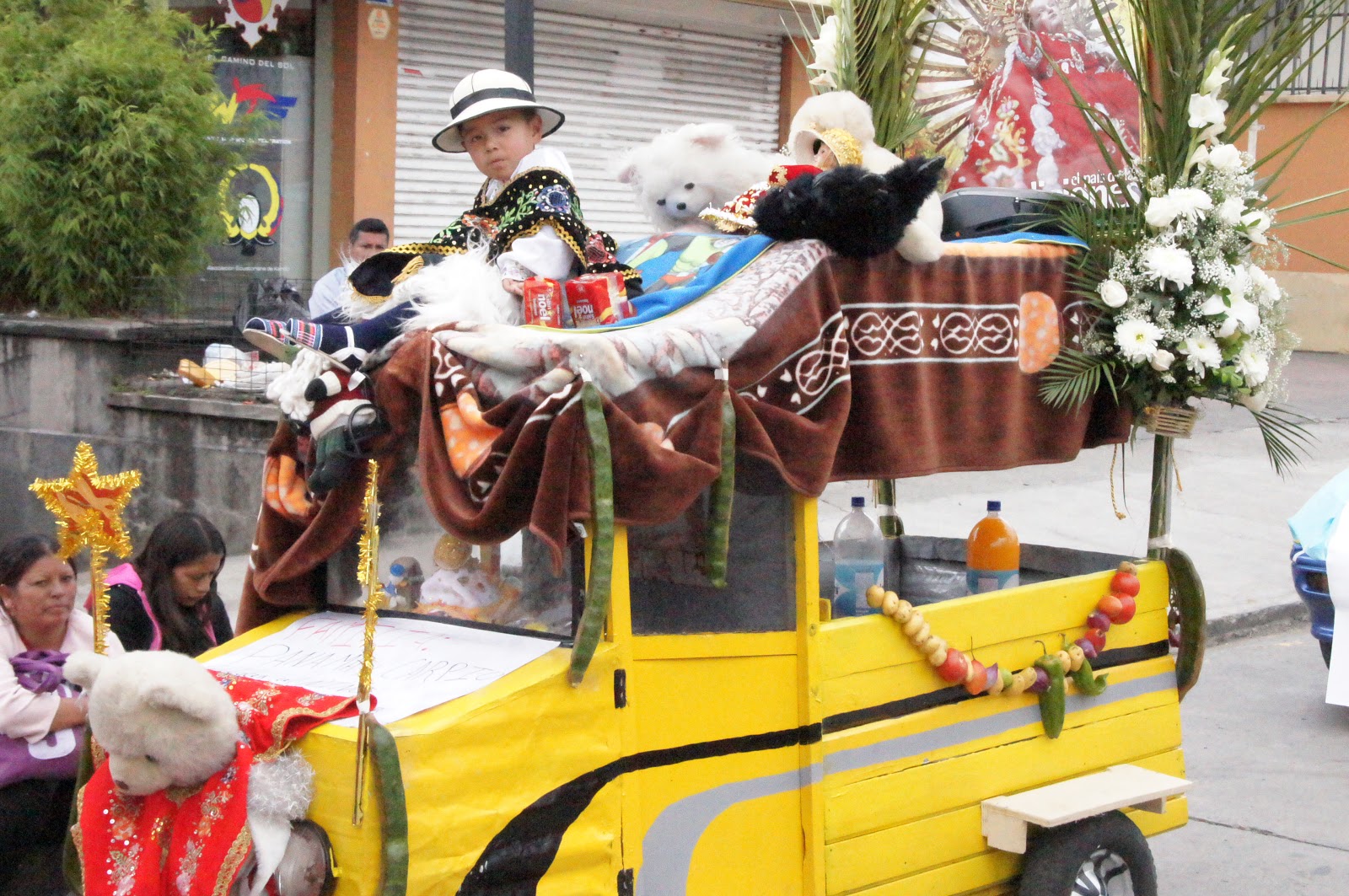
The 24th of December is very special in Ecuador because of the Children's Parade is held on that date every year.  It does not matter if you are in a large city, small town and a tiny village, they all celebrate this special event.  Here in Cuenca it was "scheduled" to started at 10:30AM.  The process of "getting in line" starts much earlier than that.  I heard from a friend that she had walked down to the staging area at 7:30 and there was about a mile of "floats" already in line.


Loved this "float" with all the hats as decorations
 
 
There were beautiful horses decorated for the parade 

Ed and I took a taxi down past our Super Maxi Grocery store to the traffic circel at 11:30 and walked up and down the street to see all the floats and kids.  The parade had not started at that time and we later learned it didn't even start until 2:30PM - that is what we mean by the "slow process" here and that means for everything.

It was the children that stole my heart.  Their costumes were darling and many have meanings: Joseph (wearing a curly blond wig), the three Wise Men, angels or in their many types of native dress.
 

These two boys were not together but their dress was the same
 
 
On the back of this float, a lady was roasting Cuy or Guinea Pig, which is a very local dish in Ecuador and Peru.
 

This beauty posed for me and enjoyed seeing her picture afterwards...
 
Here is the blond wigged Joseph - so cute.  I saw many wearing this same costume

There was just lots of waiting for the parade to start, these kids were on the back of a float.
 
Something to eat makes the time pass faster
We saw lots of children being fed to help keep them happy 
 
This float has music playing and this little guy was singing along


This little girl with the lolipop in her mouth reminded me of my granddaughter, Adrienne.


Looking down the closed street where they were staging for the start of the parade

Now this brings back some good memories - we owned a 1980 Busser and drove it across the U.S a couple of times....
 
I had walked down about a half of mile to see the floats and kids.  My foot was starting to cause me pain and that was a lot of walking for me.  We needed to stop and have pizza for lunch before heading back to the condo to allow me to ice my foot.
 
Loving our life in Cuenca... all is good,
Peggy